
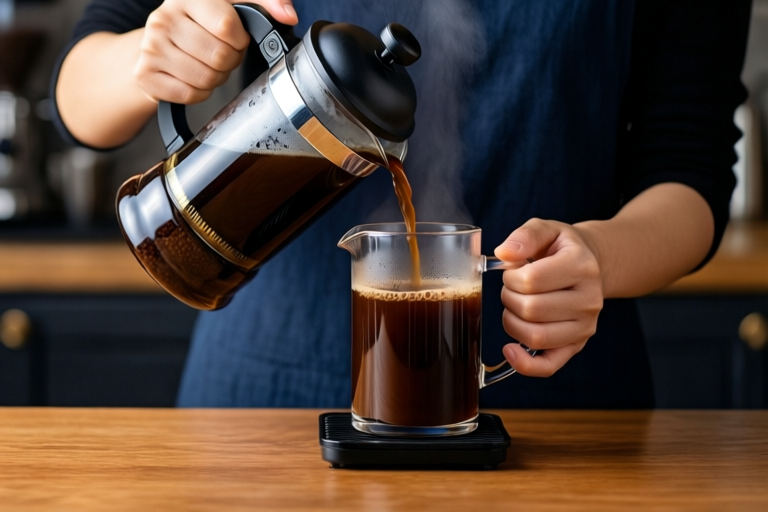
French press coffee is full immersion brewing: water and grounds stay in contact for the entire brew, then a metal filter separates most of the particles when you plunge. That long, even contact is why it can taste rich and textured when dialed in. If your cup swings bitter, sour, weak, or muddy, small variable changes usually fix it fast.
Method Overview: Why French Press Works
Unlike drip methods where water passes through quickly, French press relies on steeping. You control extraction with grind size, brew ratio, water temperature, time, and agitation. Start with a repeatable baseline, then make one change at a time. For foundational context, review Tea & Coffee Guides and the dedicated Brewing Methods library.
Variables That Matter
- Grind size: Use coarse, even particles. Too fine increases bitterness and sludge.
- Ratio: A practical starting point is 1:15 to 1:17 (coffee:water by weight).
- Water temperature: Aim for 92–96°C (198–205°F) for balanced extraction.
- Steep time: 4:00 is a solid baseline; extend slightly for lighter roasts.
- Agitation: Stir gently after bloom; too much agitation can over-extract fines.
- Bloom: A short bloom helps release trapped gas in fresh coffee.
- Filtration: Metal mesh preserves oils and body but lets some fines through.
To understand how grind and extraction interact, see Grind, Water & Extraction and Coffee Basics. Industry references from the Specialty Coffee Association and National Coffee Association are useful when calibrating your own recipe.
Step-by-Step French Press Recipe
Step 1: Preheat the French press and your mug with hot water, then discard. Weigh coffee and water at about 30 g coffee to 480 g water (1:16), grind coarse, and add grounds to the empty press.
Step 2: Start the timer and pour about twice the coffee weight in water to bloom for 30–45 seconds. Pour the remaining water to target weight and give one gentle stir to wet all grounds.
Step 3: Place the lid on with the plunger pulled up and steep until 4:00. Break the crust gently and skim foam if desired.
Step 4: Plunge slowly and steadily, then serve immediately to avoid over-extraction in the beaker.
Outcomes and Exact Adjustments
- Bitter: Grind slightly coarser, reduce steep to 3:30–3:45, or lower water temp by 2–3°C.
- Sour: Grind slightly finer, extend steep to 4:30, or raise water temp by 2–3°C.
- Weak: Increase dose (e.g., 32 g to 480 g), or keep dose and grind a touch finer.
- Muddy: Go coarser, reduce agitation, plunge slower, and decant immediately.
If you want side-by-side method comparisons, the Bodum French Press guide gives a useful manufacturer baseline.
Frequently Asked Questions
What matters most when adjusting French press coffee?
Grind size, brew ratio, water temperature, steep time, and agitation matter most. Change one variable at a time so you can taste the effect clearly.
Why does French press coffee taste muddy?
Muddy coffee usually comes from a grind that is too fine, too much agitation, or plunging and pouring too roughly. Use a coarser grind and decant gently.
Can I make French press coffee less bitter?
Yes. Try a slightly coarser grind, shorter steep time, lower water temperature, or a little less agitation before changing several things at once.
Should I serve French press coffee right away?
Yes. Pour it out after plunging so the coffee does not keep extracting in the press.
How should beginners test changes?
Keep a simple baseline recipe, then adjust only one variable per brew. This makes the result easier to understand.
For more practical kitchen technique guides, visit Knife Kettle. For coffee technique, review Specialty Coffee Association brewing resources.
